
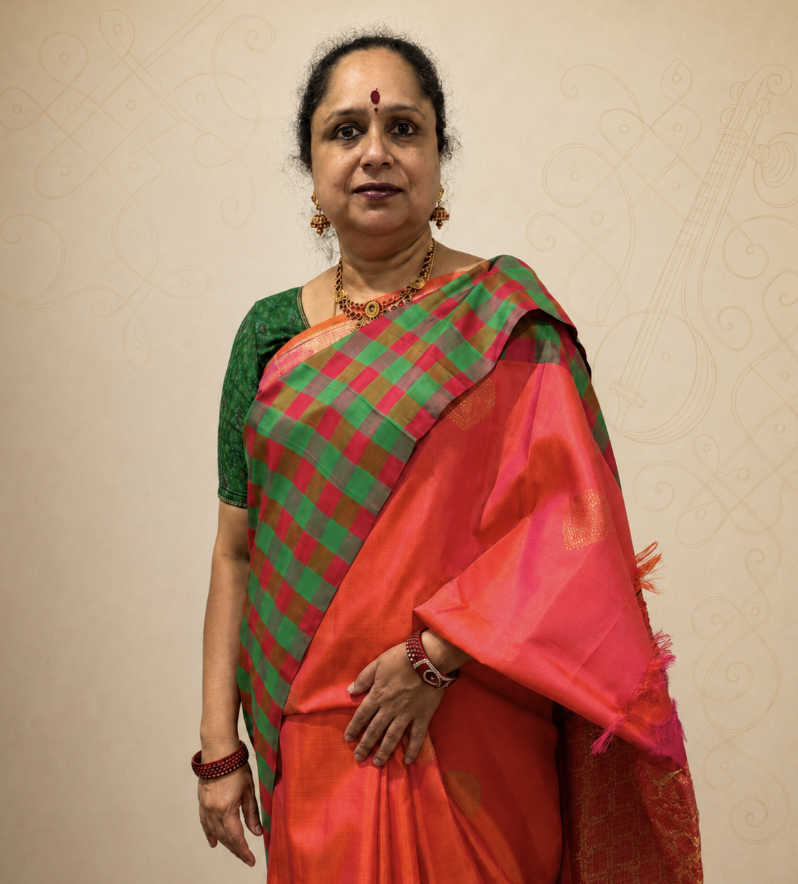
Music was part of everyday family life for Shobana Sujitkumar, who grew up in Chennai.
Her athai—her father’s sister—would seat her on her lap and recite the Narayaneeyam, pasurams and other devotional verses. By the age of three, Shobana could recite Bhaja Govindam.
She was drawn not only to Carnatic music but also to listening to different artists and their interpretations. “Rangapura Vihara” was a household song; attending kutcheris became a regular part of her life.
Marriage opened a new chapter in her musical journey, with her husband and his family encouraging her to continue her passion. When she moved to the United States in 1995, her suitcase was filled with Carnatic music cassettes. She still has tapes her husband bought for her that year, with recordings of M.S. Subbulakshmi among her favourites.
From house concerts to SR Fine Arts
In the Bay Area, Shobana’s childhood friend Kanaka Guruprasad, knowing her passion and love for the art form, introduced her to Pat and Godha Krishnan, who started house concerts for Ramanavami, in a 3-day festival format from 2006, at their residence. There was little social media then. Invitations travelled personally, and guests arrived carrying a homemade dish.
“You made a dish and went,” Shobana recalls.
Thiruppavai programmes and concerts took place in people’s homes. At these gatherings, Shobana noticed how many children in the community were learning music seriously—and how few opportunities they had to perform.
That observation eventually led her to establish Sri Ranga Ramanuja Maha Desikan Fine Arts, better known as SR Fine Arts, in 2012. The organisation was inaugurated by Anuradha Sridhar, with Anirudh Venkatesh as its inaugural performer. Its first concert was presented by Hrishikesh Chary.
SR Fine Arts became a nonprofit in 2014. That December, Shobana also started Krishnageetham Performing Arts, a dance branch named for her parents, Krishnan and Geetha.
She credits five young musicians with inspiring the organisation’s early journey: Ashwin Srikant, Guhan Venkataraman, Hrishikesh Chary, Vignesh Thyagarajan, Vignesh Venkataraman.
What was extremely important was ~ the many Gurus within the Bay Area’s artistic ecosystem who embraced S R Fine Arts and have remained steadfast supporters over the years. One early example was from senior Bay Area vainika and guru Srikanth Chary: daughter-disciple Priyanka presented her first full-length concert through SR Fine Arts, which he called, her Arangetram. Several students from his school, Nadanidhi, have since presented Arangetrams through the organisation. Shobana remains deeply grateful to him and the wider community of Gurus whose trust, encouragement and continued support have been integral to SR Fine Arts’ journey.
Experimenting with the concert format
SR Fine Arts began with a youth festival. But defining “youth” proved unexpectedly complicated: should the age limit be 21, 25 or something else?
The event eventually became Sangeethotsavam, welcoming performers from across North America. Today, applicants may wait between six months and a year for a performance opportunity.
The organisation has also experimented with concert lengths, offering formats ranging from one to three hours. Ashwin Srikanth was the first to present a three-hour concert.
That experiment confirmed that musical enthusiasm may be abundant, but three-and-a-half hours still requires considerable staying power. The longest format was subsequently reduced to three hours.
In 2018, SR Fine Arts introduced Yuvatarangini for young artists preparing to leave for college. It gives them an opportunity to present a solo or duet before academic schedules take over. What began with five performance slots has expanded to seven because of demand.
The organisation has also presented thematic programmes and formats pairing senior artists with junior accompanists.
“We keep experimenting.”
The work behind the stage
One of Shobana’s early challenges was audio. In the beginning, parents with technical knowledge stepped in to help. She later purchased equipment from Guitar Center, and SR Fine Arts now works with a regular audio professional.
Anyone who has organised a community concert knows that the microphone cable can generate almost as much tension as the main performance.
Shobana also speaks openly about attendance for concerts in the local music community. With many schools and organisations presenting events, concerts frequently clash. Attendance can become reciprocal: one family attends another child’s concert with the expectation that the gesture will be returned.
She hopes families will listen more widely and support musicians outside their immediate schools and social circles. For students, she believes, attending concerts is an essential part of learning.
Shobana says she began SR Fine Arts because she enjoyed the work and wanted to create opportunities for emerging performers.
Outside music, Shobana’s love of sarees led her to support weavers during the pandemic. In 2020, she started Thaayaar Silks, named for Ranganayaki Thaayaar.
More than a decade after SR Fine Arts began, applications, scheduling and production are largely handled by Shobana herself. The audience sees the finished kutcheri; she sees the emails, forms, sound checks and last-minute adjustments that made it possible.
But the purpose remains simple: the Bay Area has talented young musicians, and they need places where they can be heard. More than a decade later, Shobana’s purpose remains unchanged: to give young musicians a platform, and the experience that comes with using it.